A couple of years ago, a Facebook livestream showing the assault on a man by a group in the centre of Ljubljana went viral. Thousands watched the violence unfold without anyone calling the police. This real-life incident serves as the starting point for the reflection and condemnation underlying Observing, the new film by Janez Burger, co-written with the recently departed Serbian screenwriter Srđan Koljević. Premiered at the national Festival of Slovenian Film, before heading to its international premiere in the Critics’ Picks section of Tallinn’s Black Nights, and now to Trieste, Burger’s mix of horror and film noir presents a bitter reflection on the influence of media on our society and the voyeuristic pleasure inherent in many of us.
It starts with the incriminating video, which is not initially shown on-screen, and narrates the almost divine punishment that seems to await all those who have stained themselves with the sin of apathy, watching violence from the sidelines and, in some cases, even deriving pleasure from it. Witnessing this series of inexplicable and unsettling events is paramedic Lara (Diana Kolenc), who, after assisting the victim of the assault, begins to receive from his phone, while he is in an induced coma, videos showing the next victim, inevitably involving her in this sadistic game.
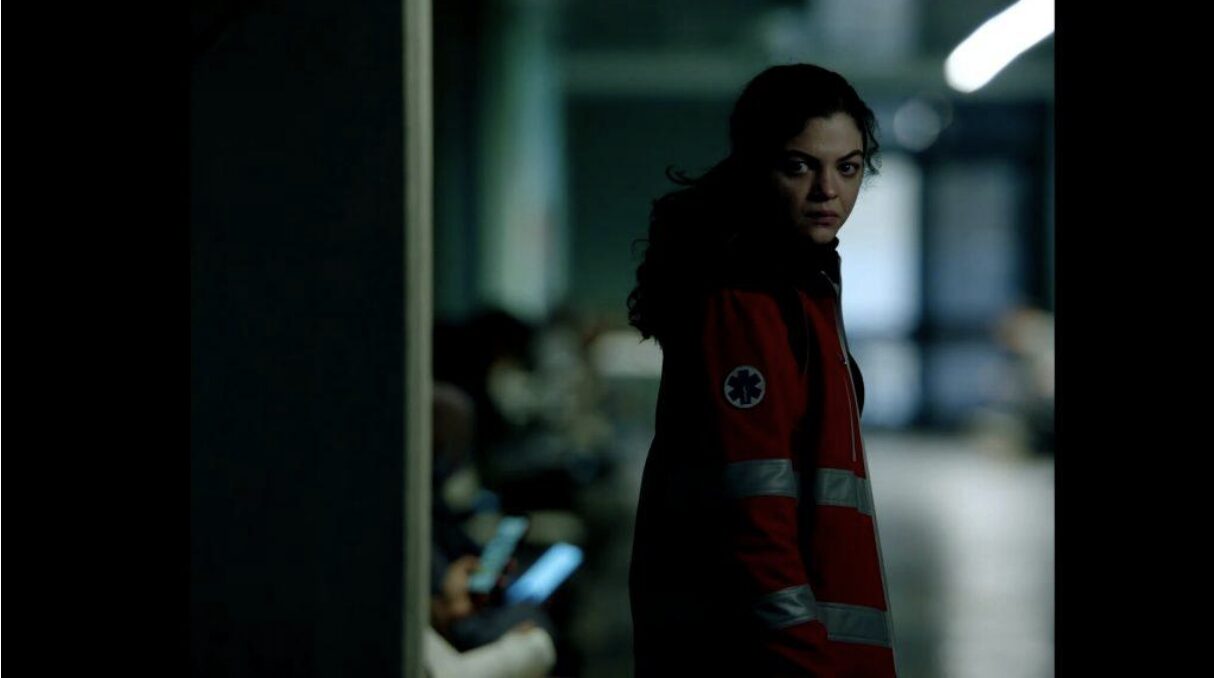
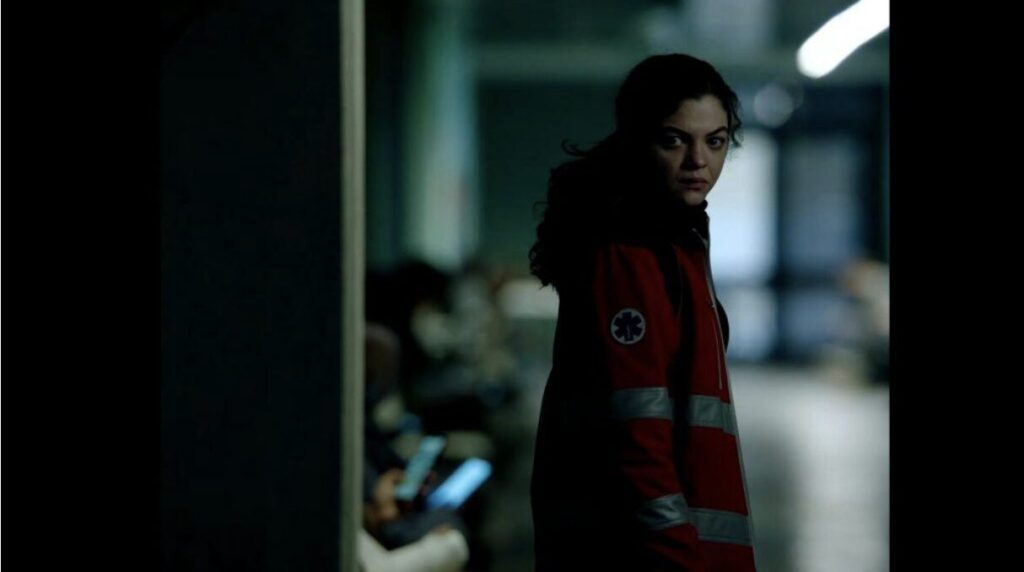
The film puts the viewer into the forbidden pleasure of spying on other people’s lives and compelling them to watch Lara’s life from a distance. The concept behind Marko Brdar’s cinematography is to capture events as if filmed on a hidden camera: the characters are often reflected on various surfaces and screens, with the rest of the setting kept out of focus, with low or overhead shots being consistently obstructed, framed by doors and
pieces of furniture, providing only a partial image of the represented reality. The characters mostly occupy only one-third of the screen, with the 4:3 aspect ratio being even further constrained by the internal framing of the small, cramped spaces they inhabit. This approach breaks down the scenes into even smaller segments, amplifying the claustrophobic, suffocating effect and the characters’ alienation, lacking any sort of human
connection. The only ones to always appear united and close in the scene are the two sisters, Lara and Ema (Nataša Keser), and their family, while all the other characters remain functional figures, almost extras in the protagonist’s life.
The predominant use of indoor scenes in dark environments such as ambulances, elevators, and mortuary rooms, and of artificial, low-intensity lighting that casts long shadows over the characters, enhancing, in particular, the expressiveness of the newcomer Kolenc (who won the Best Actress Award for the role at the national festival), heightens the sense of unease
and fear in both the protagonist and the audience. The colour palette limited to grey, blue and green emphasizes the feeling of oppression and inevitability looming over the characters who are dressed in the same tones, blending with the surrounding environment and intensifying the claustrophobia. The horror comes from the shape of a cat-and-mouse chase, but it is a victim that will soon become the perpetrator. It’s not coincidental that mice, a typical element of the genre, appear unexpectedly and inexplicably multiple times in
the film, in a crescendo that coincides with the increasing number of victims.
Many unresolved elements align the film more with horror than with a thriller, where the striking force appears to be a punitive deity acting through social media. The intention does not seem to be to tell a story but to lead the viewer to question their humanity and sense of empathy, placing them face-to-face with their responsibilities. Indeed, the film remains a hybrid: a dark and expressive work that begins with the tones of a thriller, only to evolve into supernatural horror and conclude with an abrupt, unresolved ending—an almost self- contained moral denunciation. While its experimental aesthetics and cinematography make
it particularly expressive and engaging, the writing falters, especially towards the end, lacking a defined identity that renders it a partially successful attempt. The film does not narrate, it denounces; doesn’t provide answers, it condemns. This appears to be its stylistic signature, concluding by showing the incriminating video and breaking the fourth wall to directly address the viewer with the key moral question: would you have watched the
video?