Series Concept
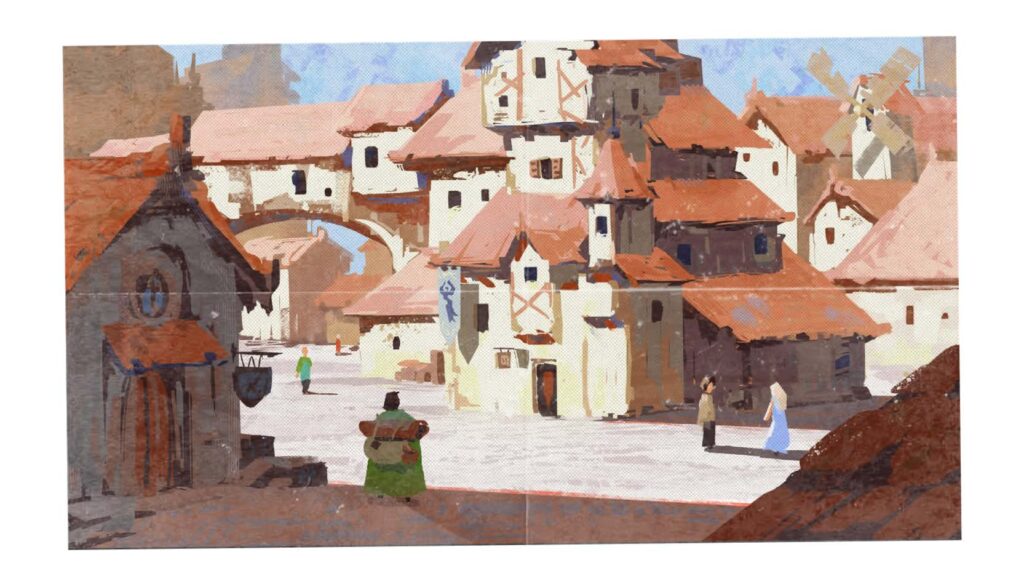
We are inside a Fantasy Videogame, specifically an old-generation RPG. Within the enormous Game Map, in one of the starting villages, there is a small shop in which the Merchant of Fenik and the Merchant’s Wife (♀) work. In technical jargon, they are NPCs (Non-Player Characters), whose role is simply to sell equipment and basic items to the players who regularly stop by the village. Their lives, like those of all NPCs, run quietly in the service of the Heroes of the Game, who, game after game, retrace the history of the video game, resetting the world each time the main campaign is completed, in an eternal gameplay loop. For the Merchant of Fenik, there is nothing more reassuring than an endless loop that always repeats itself in the same way. His wife, on the other hand, comes across as a character who is tired of and opposed to the mechanics imposed by the game: she chooses to give herself her own name, Leah, to distance herself from her identity as an anonymous NPC, and to lead a different life.
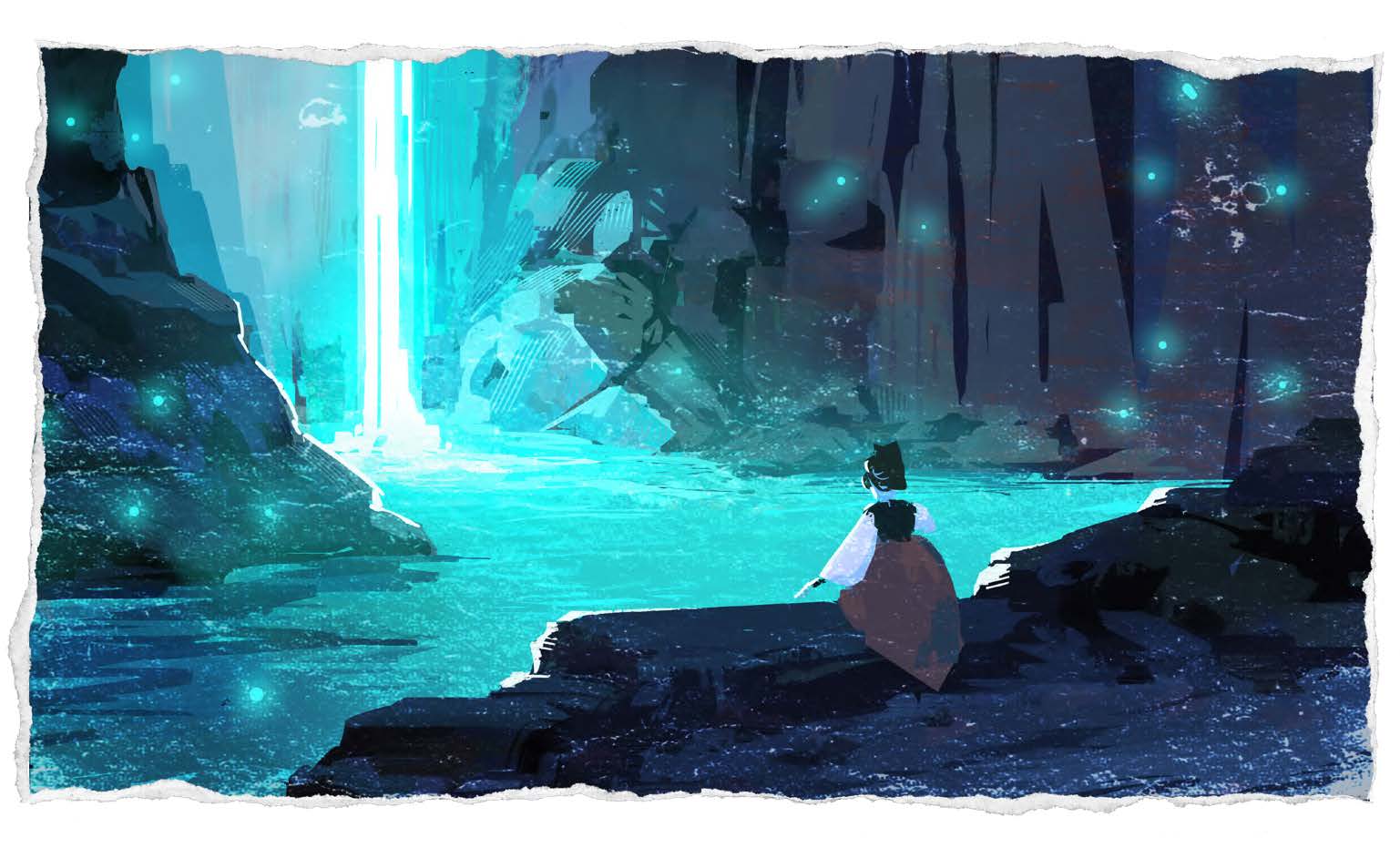
After another quarrel with her husband, Leah decides to leave the barrel and attempt to escape from the same old reality, defying the limits imposed by the the video game. In doing so, she unintentionally causes a system error that hits her and drags her off the Game Map, trapping her in the Sub-Game, the computer core where all of the game’s system files and bugs reside. The Merchant will have to abandon his shop, step out of his comfort zone and embark on a journey to rescue the woman before the Heroes of the Game arrive to complete the main campaign, thus resetting the story and causing the erasure of everything outside the Map of the game.
To complicate things is an encounter with Arty, an evil little demon in the shape of an artichoke. He is one of the many lower-level enemies that players come across at the start of the game and whom they eliminate again and again, at every match, to gain experience points. Tired of being defeated at every restart, he is also headed for the sub-game with the intention of preventing yet another reset and crashing the entire system. Despite their totally opposite aims, the two discover that they are heading for the same goal and decide to join forces to slow down and counter the player-led Heroes of the Game party together.
During the journey, the two will encounter situations that will shake their convictions: as the Merchant discovers the world outside his shop, coming to understand and share his wife’s longing for freedom, Arty begins to grow fond of the Merchant and to feel a sense of community that makes him feel part of something. The initial duo will get to know new characters who will decide to join their adventure, thus forming a true Game Party, composed of NPCs, capable of reaching the final level of the Veiled Isles that hides the entrance to the Sub-Game.
Here, after rescuing Leah, the group discovers that each NPC code has unexpressed potentials and characteristics that individual characters could develop if only they were given a choice. The Merchant then understands that ‘breaking the game’ does not mean destroying life on their world but, on the contrary, freeing it from the dynamics of a predetermined narrative. The other characters then rely on his intuition, finding themselves catapulted into a post-game Open World where everyone is finally free to follow their own personal mission, dictated only by their own dreams.
Theme
The pivotal theme of the series lies in the search for free will and leaving one’s comfort zone in order to find one’s place in the world. A number of important sub-themes are connected to this theme, which characterises the transformation arc and personal growth of each character. These include: love, habit within couples, routine, the need for community and family, dreams and natural inclinations.
The Protagonists
MERCHANT OF FENIK
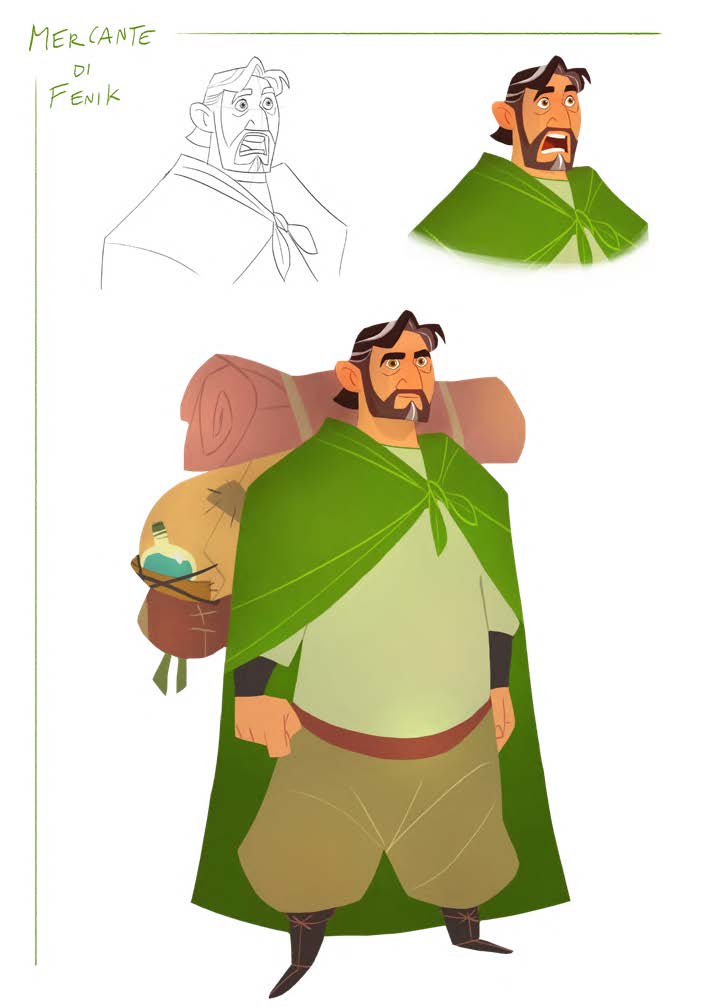
PERSONALITY: A middle-aged man who fits perfectly into the logic of the game loop. He serenely lives his NPC status and the continuous reset of the story. He works as a merchant in a shop together with his wife. The man is deeply loyal to the rules of the game and cannot imagine a different life away from the game dynamics. He is proud to be a marginal and secondary character and has never wanted anything different.
THE STAKES: With the disappearance of his wife and the subsequent decision to set out on a journey to find her, the Merchant will have to abandon his comfortable position and question his own beliefs for the first time. He will have to reach the Sub-Game to save his wife before the Heroes of the Game complete the main campaign and reset the game, permanently eliminating everything outside the borders of the Game Arena, including the woman.
EVOLUTION: Thanks to the journey, the Merchant will acquire a new awareness of himself, of the concept of free will and will experience true love, previously only imposed by the game mechanics. The quest will test him on several occasions, prompting him to make decisions and act in complete autonomy, until he is recognised by the system itself as a Playing Character. Thanks to his final intuition to each NPC is finally given the chance to unlock his own potential, by updating the game system and making the videogame an Open World, no longer subject to loop logic.
ARTY
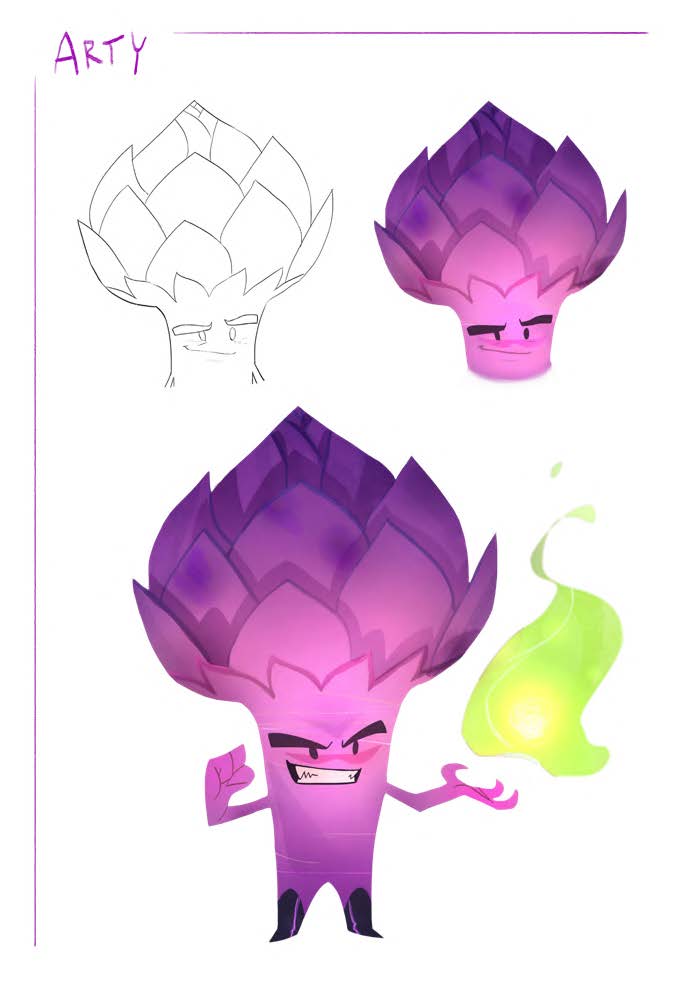
PERSONALITY: Small, evil demon in the form of an artichoke. He is one of the many enemies that the players come across at the start of the game and whom they continually defeat. His inoffensive features and nickname only increase the frustration and dissatisfaction caused by his insignificant role in the game. For this reason, Arty makes the decision to crash the entire system, in a suicidal gesture dictated by his inability to feel perfectly integrated into the world in which he lives.
GAME POINT: In order to destroy the Game Arena, Arty must reach the Sub-Game, but his nature as a wild demon does not allow him to move freely within the villages and places on the map. Recognising the Merchant as a possible companion, and thus a unique opportunity to move freely within the Game Arena, he tries to win his trust by telling him and his fellow adventurers that he is searching for his family – a ridiculous lie that is later exposed along the way.
EVOLUTION: During the journey, Arty will go from being a profiteering and selfish character to a true member of the Game Party, developing a bond of friendship with the other members and especially with the Merchant, recognising in them the family he never had. He will, however, keep his character traits: his fiery temperament, his belligerent outlook and that troublemaker attitude. Arty is the Merchant’s mirror and counterbalance. The two will grow together, spurring each other on and becoming the typical friend-enemy pair that will generate the most disparate dynamics within the story.
Tone and Genre
It is an animation series with comic and parodistic tones, which often result in a caricature of the epic fantasy. There is no shortage of fairy tale and adventure elements revolving around the construction of the hero figure and the journey he makes (see Final Fantasy IX or The Legend of Zelda). The series is conceived in Traditional Animation (2D), recalling the aesthetics and illustrations of role-playing games such as Dungeons & Dragons, but always remaining on comical and almost parodistic atmospheres (see Matt Groening’s series, Disenchantment).
It therefore draws on a certain type of medieval fantasy reminiscent of Tolkien’s Middle-earth, as well as on more fairy tale-like characters and game mechanics typical of the RPGs of the Final Fantasy saga. The game interfaces, counters, energy bars, level-ups; these elements are, however, presented in 2D graphics, following the stylistic choice of the more recent Ni No Kuni, a video game that offers a deliberately two dimensional look in its animations and game graphics, which, not surprisingly, sees the collaboration of Studio Ghibli, whose films represent another important reference for the look of the settings and places of the Game Map.