The bells of St. Clement’s Church rang six o’clock above the dust-blue roofs of old Oxford. It was late April. The fresh smells of English spring rose from the lawns around the colleges and crept into the narrow streets packed at the corners by the noisy patrons of the pubs, crowded in the late afternoon. The still warm light painted itself on the bread-crust coloured buildings, refracting in the air all around.
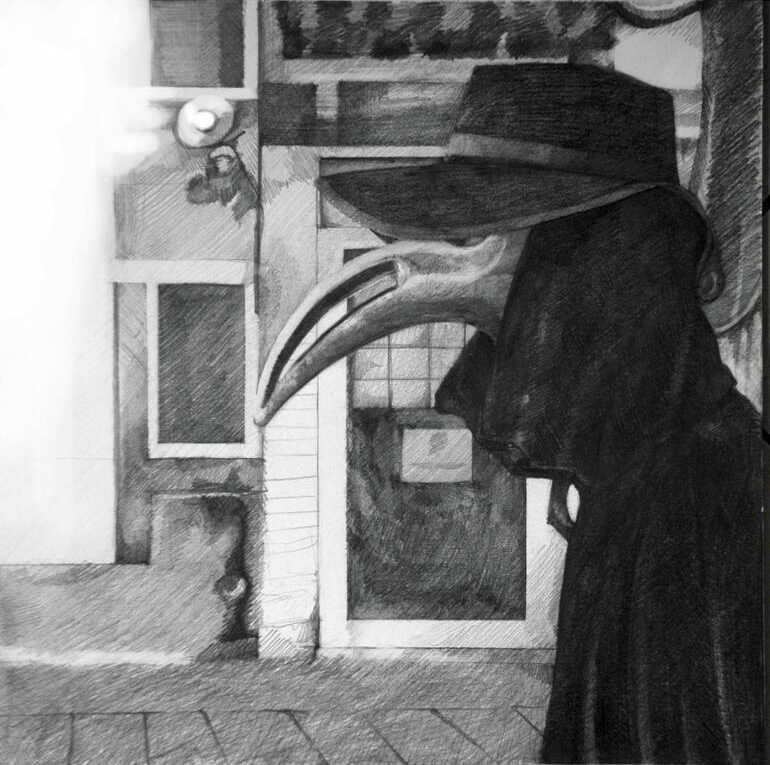
The days were longer, he thought, dismounting from his Mark 2, nervously closing the door behind him. Two students on bicycles quickly dodged him, laughing to themselves as he crossed the street. He was going to enjoy a good pint, he told himself, as he entered The Wolf’s Head pub, already quite full at that hour. The semester was drawing to a close and inside many academics and students were savouring the certainty of an upcoming period of freedom. Swaddled in their ample black togas, as if to distinguish themselves, they resembled the plague doctors of 18th-century Venice. All they were missing was the long-billed mask, inside which they would not, however, have smelt the aroma of beer and scotch.
He thought about how out of place he must look, with his dark clothes, long mackintosh and drawn face. He had no illusions about his appearance, but he did not mind. He felt no desire to join them. Once he had tasted that life, once he had been one of them… but what was he saying! He had never been one of them, perhaps that was why he had left, just a step away from graduation. With a bitter smile, he thought that was his condemnation: to remain an eternal outcast, forced to always observe from the outside and always, yes always, notice those little details that others missed. He was reminded of what that little girl had called him, a moon-eyed man, someone who, according to an ancient Cherokee myth, is blind in daylight but can see clearly in the darkness. Maybe he really was like that. And he liked it, yes, he liked it. He was good at what he did and, as much as he felt a certain distaste for it, he couldn’t have done anything else with his life.
He approached the bar and asked for the usual lager, dark, cloudy … he had never dwelt on that colour, but he realised that it matched his life perfectly. The young barmaid smiled at him as she served him and asked politely how he was doing. “Same as always,” was his elusive reply. He smiled at her, almost apologetically, as he grabbed the Oxford Mail and sat down, opening it, as was his wont, to the page of crossword puzzles to beguile the wait.
From his pocket he took out a pen and paper and began to write, a list, a series of hypotheses, of possibilities. His logical sense, his cold analysis, those skills that had made him a good policeman, would have helped him. The others, his colleagues, were saying it too, sometimes through gritted teeth, whispering among themselves.
He had not been back to Oxford for years, since he had enlisted with the Royal Corps and left his studies. His had been a sudden decision, the result of an impulse he himself had not been able to make sense of. He had always been at the top of his class, had excellent results in Latin metrics and English literature, yet he felt that something about that environment of privilege and inequality did not belong to him. If he had continued he would surely have become an academic, everyone knew that. He could almost imagine that life, see it from the outside, distinguish its division into acts, the inevitable twist in the middle of the second and the relaxation of the third, he knew its dramatic tones and the quiet notes at the end. A professorship, a toga, then a wife, that wife, and eventually children, a petty bourgeois representation of tasty and pleasant execution.
He loved opera, Puccini in particular, but only in the theatre did he like to suspend his disbelief. In everyday life he preferred to remain alert, stimulated, like when he set himself crosswords. That was how he wanted to live, letter after letter, puzzle after puzzle, not knowing where the next riddle would take him. He wanted to exercise his wit, not waste it on the yellowed pages of books that had now exhausted all their deepest meanings. Something else had called him back, something obscure, something hidden that he would not find among the ancient wooden desks of the university. He liked to pretend, at least with himself, that he was above what others were striving for, those vague, petty ambitions, the exasperated passions that assail human nature and lead them to take each other out. He had seen it too many times. All too many times he had seen death in the face, the extreme doggedness in hurting the other, the brutality etched in the victims’ barred eyes like images on film.
He could not bear the sight of the slaughtered bodies, the violence found its justification only in fiction, on stage, diluted by the great passions and beautiful singing of the performers. In real life there remained only an abomination that he had to clean up, erase, as far as he could. Perhaps that was why he liked the role of spectator, in the streets as well as at the opera. He did not want to mingle with those dramas, he only liked them purified in art or reflected in the eyes of others.
So he was gone. Had he run away, perhaps? Even from her? For years he had been telling himself, no, he had not. But something still remained unsolved, something his clear mind had not been able to grasp, a riddle not yet solved. So he was back. Not for her, he told himself. He had told her father, in his dying bed, when by now delirious he spoke only of races, horses and bets. He had told him, he was not the type to make the same mistakes twice. He had told himself that for all those years, but there remained that image that chased him, that he couldn’t shake, her, the dark blond of that hair, that halo that surrounded her face, lit by the natural light from the dusty window. He had recognised that colour immediately, the night before. It stood out among all those piled up in the room.
It was hard not to notice her, in those gloomy classrooms, among those old wood panelling, all dark in their black robes. The head of hair, that slender figure, the squeaky voice, anyone would have noticed her. Particularly on that occasion. They were commemorating a dead man, with that dignified and somewhat detached style typical of formal ceremonies….
Professor Bradbury was dead. Falling disastrously from the college’s grand staircase, his heart had stopped. Suddenly, it seemed. Of course there had been an inquest, a necessary formality in such cases. He had offered to help. He knew Professor Bradbury, he had been his teacher for his short time at Oxford, when he was just a thin, silent pupil and, according to the Professor, promising. A peculiar fellow the Professor, reserved, shy, very knowledgeable in his subject, he could answer all his pupils’ questions with acumen.
He was a bachelor and still quite attractive. Quite a few girls in his class were making goo-goo eyes at him, he remembered well. But not her. She cared for no one, she walked casually through the corridors, her distant gaze making her even more intriguing. An enigma. Was it a simple attitude or a genuine character trait? So it was that they started dating, secretly, in spite of the high aspirations of her family. That had been perhaps the most carefree period of his life, something that had never been repeated. But their secret meetings were soon replaced by long silences and prolonged absences. She became more elusive, reserved. She spent more and more time in Professor Bradbury’s office in longer and longer meetings discussing a possible doctorate. Things changed, slowly, inexorably.
Now Bradbury was dead, following that disastrous fall, without major trauma, only his heart had stopped. The police had already filed the case, nothing suggested anything suspicious. It could happen, they said to themselves, it had already happened that following a bad fall someone had suffered a cardiac arrest. Of course one could always fall from a ladder, one way or another, ladders were always treacherous. Yet something did not convince him. A memory, a strange foreboding had surfaced. That was why he had returned to college a couple of days earlier.
He had come in, towards evening, when there were still no lights on, to look carefully at that staircase. He had climbed it several times and had descended it several times, with regular steps. It was not a particularly steep or dangerous staircase, this seemed to him on first examination. He had also quickened his pace, going up and down. Nothing in particular. He had looked carefully under the ladder, in the cracks between the planks, in the recesses under the steps. Nothing, really nothing. He had scrupulously tried to slip his hand underneath, between one crevice and another, and, behind a small indentation, a hidden part of the frame barely protruding, he had felt something, leaning in. He had found in the palm of his hand a brooch, not too large, of hard stones, agates and garnets, of 19th-century, Victorian make.
Nothing strange, he had thought, small objects can disappear and get in the way. He looked at it closely, a short distance from his eyes. The needle clasped in its safety still held a piece of fabric, not so small, rather dark green, caught in its silver core. It looked as if the brooch had been torn from the dress with force.
That brooch. He thought he had seen it before, but was not sure. Yet that style, the hard, semi-precious stones set in that particular way to recreate a coat of arms reminded him of something. It was no insignificant object and whoever had lost it must have noticed its absence, surely they were looking for it, anxiously, if they knew it could be linked to that fact. A memory resurfaced in him. A memory of those years. Her, her blonde hair down on a dark green dress and that brooch. He kept pushing that image away, hoping it was just that, an image and nothing more.
She seemed nervous when they had seen each other again, she kept running her slender fingers through her hair, restless. She knew he was in the police, did she have more information about that sudden death? Bradbury was her tutor, the whole thing had shaken her up. It was only natural. He wanted to get to the bottom of it at all costs. So he had set a bait, he had phoned her disguising his voice. If she wanted the brooch back, he would have to pay a fair amount. The appointment would be at the pub, the next day, at eight o’clock. He would wait until eight o’clock, then leave.
The door kept opening, in came the pale-faced employees who had shrugged off that day’s work, the usual regulars who greeted everyone, the dressed-up girls who, two at a time, cast winking glances at the young people sitting in groups, huddled around those tables. Nothing strange, nothing different from a normal evening at the pub. He hoped that door would not be opened at eight o’clock, not to let in a head of dark blond hair. He looked at the big clock behind the bar. A quarter to eight. He tried to distract himself by going back to his crossword puzzle, but he kept glancing at the massive door. Five to eight. Eight o’clock, more patrons came in, more than one, fortunately none with blond hair. Quarter past eight, then twenty-five. With a smile he went to get another beer. He sat down and looked up. The door was opening, just then. He stood still, staring at that slightly long elegant dress and that head of dark blond hair.